
AI Tools & Workflow
Beyond Chatbots: The 7 Core Layers to Building Truly Agentic AI Solutions
(And How to Leverage Them for Business Growth)In the early days of generative AI, the focus was simple: how can we get a language model to sound like a human? Fast forward to today, and the question has fundamentally changed.
Business leaders across the UK are no longer asking if they can use AI. They are asking: "How can I make AI do something for my business?"
This shift from simple chatbots to sophisticated, autonomous systems is the dawn of Agentic AI. An agentic AI solution doesn’t just answer a question. It understands your business data, makes complex decisions, uses external tools, and performs a series of connected tasks to solve real problems—from content generation and lead qualification to customer support and product fulfillment.
But how do you build an architecture that transitions an AI from a novelty to a value-creating engine? At Zapyan, we’ve spent thousands of hours engineering and integrating these solutions.
This is our blueprint for building robust, multi-layered agentic solutions.
Understanding the Agentic Stack: It’s Not Just a Model; It's an Ecosystem
An effective AI agent isn't built on a single Large Language Model (LLM) alone. It’s a carefully choreographed ecosystem of layers, each with a specific functional role. You cannot build a smart, context-aware, and action-oriented system without integrating all of these components.
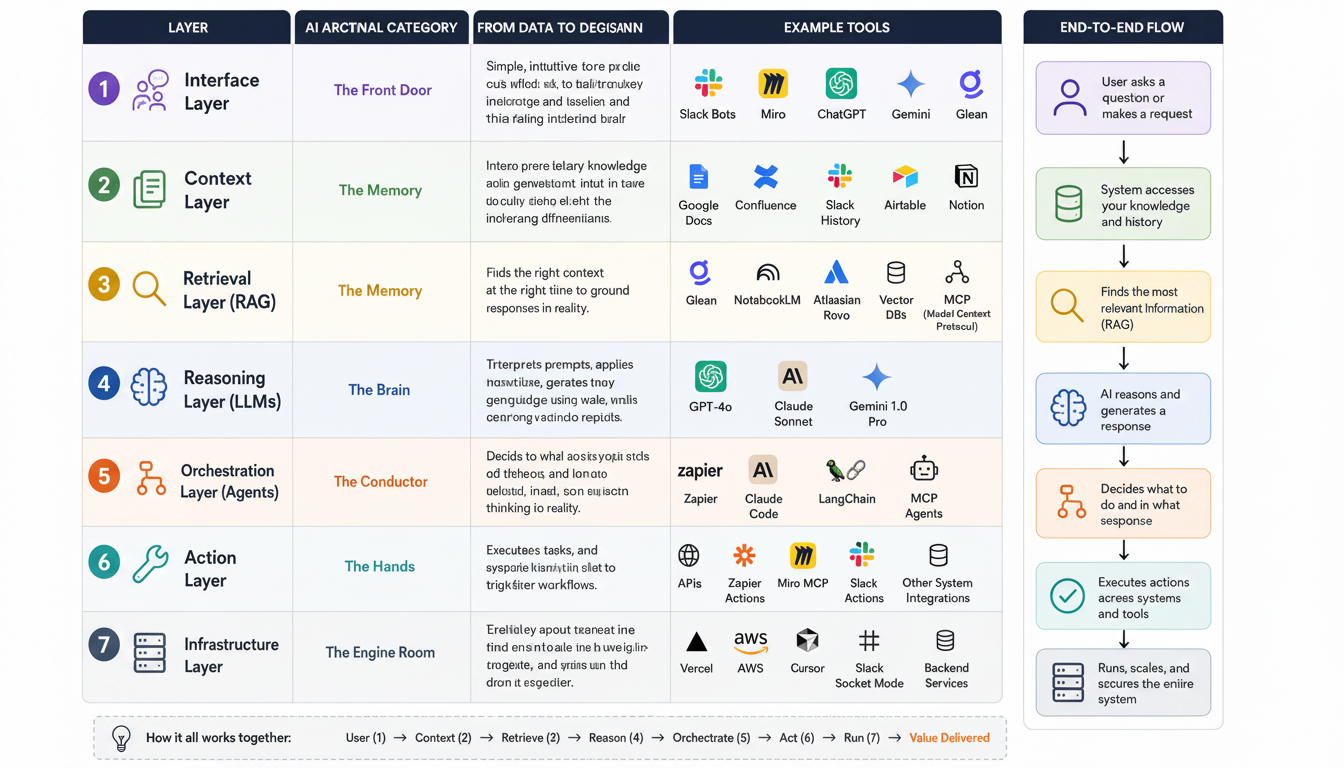
Here is a layer-by-layer breakdown of the modern AI engineering stack:
Layer 1: The Interface Layer (The Front Door)
Layer 2: The Context Layer (The Memory)
Layer 3: The Retrieval Layer (RAG)
Layer 4: The Reasoning Layer (LLMs)
Layer 5: The Orchestration Layer (Agents)
Layer 6: The Action Layer (The Hands)
Layer 7: The Infrastructure Layer (The Engine Room)
How the Agentic Workflow Operates End-to-End
Understanding the layers is only half the puzzle. To build a solution that delivers value, you must design how they flow together.
The framework below shows the step-by-step end-to-end flow of a modern agentic workflow. We build systems that follow this exact sequence:
- Request: User asks a question in the Interface (1).
- Context Access: The system connects with the Context (2) and History.
- Find Relevance: The Retrieval Layer (3) finds and prepares the most relevant data.
- Reason: The LLM (4) reasons and creates a detailed plan or response.
- Plan Orchestration: The Agent (5) decides on the next sequence of steps.
- Execute Action: The system triggers external tools via the Action Layer (6) to complete the tasks.
- Run & Scale: The Infrastructure (7) provides the power to execute the entire system securely.
User (1) → Context (2) → Retrieve (3) → Reason (4) → Orchestrate (5) → Act (6) → Run (7) → VALUE DELIVERED
The Business Impact of a Layered Agentic Solution
By building AI on this structured, layered foundation, your business can unlock new levels of capability that a simple chatbot could never achieve. This architecture allows for solutions that are:
- Deeply Proprietary: An agent grounded in your Context Layer (Knowledge Base) will generate marketing content that is perfectly on-brand and a lead scoring model tailored to your exact criteria.
- Action-Oriented: We don't just build systems that answer questions. We build systems that update your CRM, push qualified leads to your sales team, send automated proposals, and initiate product fulfillment processes.
- Highly Reliable: By separating the Retrieval Layer from the core model, we ensure accuracy and reduce hallucinations. Your agents are fact-checked by your own data.
- Scrutinized & Auditable: A structured flow makes it easy to audit the decision-making process of your agent, ensuring compliance and control.
Your Partners in Building the Future
This level of AI integration is a complex engineering discipline. It's not a software purchase; it's a strategic initiative.
At Zapyan, we are specialized architects. We use the ecosystem shown above to help UK businesses build and deploy bespoke agentic solutions that solve their biggest operational and marketing challenges. We don’t just understand the tools—we understand the architectural engineering that makes them all work together.
Is your business ready to move beyond the chatbot?
Let’s discuss how we can build a custom, layered AI agentic solution that drives real revenue growth and operational efficiency for your organization.
Meet Zapyan
Get In Touch
HELLO@ZAPYAN.COM